
Your wedding invitation is the first look guests get at the day you are planning, and the wording sets the tone before anyone reads the details. Traditional wedding invitation wording is the formal, third-person style that names the hosts, spells out the date and time, and invites guests with phrases like “request the honor of your presence.” This guide explains who hosts and how to show it, what each line of the invitation should say, how to handle names, titles, dates, and RSVPs, and includes samples you can adapt.
When your wording is settled, browse PaperDirect wedding invitations to bring it to life.

Understanding Traditional Wedding Invitations
A traditional wedding invitation is formal, centered, and written in the third person. It reads as though the hosts are speaking about the couple, with every detail spelled out rather than abbreviated. Whatever the size of the wedding or where it is held, following invitation etiquette is a way of honoring the hosts, and the wording gives guests important cues about who is hosting and how formal the event will be.
These are the elements that usually make an invitation “traditional”:
- Third-person, formal voice. “Mr. and Mrs. John J. Jones request the honor of your presence” rather than “We’re getting married!”
- Hosts named first. The people hosting the wedding — parents, the couple, or both — come at the top, followed by the invitation line.
- Formal invitation phrasing. “Request the honor of your presence” or “request the pleasure of your company,” depending on the occasion and venue.
- Names and titles written out. Full names, including middle names, with titles such as Mr., Mrs., Ms., or Dr.
- Date and time spelled out in words. For example, “Saturday, the sixteenth of June” and “at three o’clock.”
- Centered text, simple layout, and no abbreviations or slang.
Etiquette matters because the invitation tells guests who is hosting and what to expect, and it helps everyone avoid small misunderstandings. Treat the conventions in this guide as a starting point: they vary by region, faith, and family, so adapt the wording to fit your situation and your hosts’ wishes.
Who Hosts the Wedding?
Traditionally, the bride’s parents hosted the wedding, and the invitation said so. Today, hosting can be shared in many ways: the bride’s parents, the groom’s parents, both sets of parents, the couple, or the couple together with their families. The hosting line is the first thing guests read, so it should name whoever is actually inviting them.
In the samples below, line breaks are shown with a slash, and the dates, names, and years are placeholders to swap for your own.
Parents Hosting
Start with the most traditional situation, where the bride’s parents are hosting, then see how the wording shifts when the groom’s parents or both families host.
From the bride’s parents:
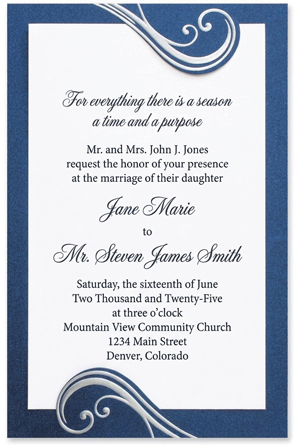
For everything there is a season / a time and a purpose / Mr. and Mrs. John J. Jones / request the honor of your presence / at the marriage of their daughter / Jane Marie / to / Mr. Steven James Smith / Saturday, the sixteenth of June / Two Thousand [year spelled out] / at three o’clock / Mountain View Community Church / 1234 Main Street / Denver, Colorado
From the bride’s parents, with mention of the groom’s parents:
A life of sharing, caring / A love of endless giving together / Mr. and Mrs. John J. Jones / invite you to share in the joy / of the marriage uniting their daughter / Jane Marie / to / Mr. Steven James Smith / Son of Mr. and Mrs. Andrew Smith / Saturday, the sixteenth of June / Two Thousand [year spelled out] / at three o’clock / Mountain View Community Church / 1234 Main Street / Denver, Colorado
From the bride’s parents (first-name style, a little less formal):
Each hour, each day, each year / We grow as two, yet as one, / We grow apart, yet together / Forming an eternal love / John and Anne Jones / request the honor of your presence / at the marriage of their daughter / Jane Marie Jones / and / Steven James Smith / Saturday, the sixteenth of June / Two Thousand [year spelled out] / at three o’clock / Mountain View Community Church / 1234 Main Street / Denver, Colorado / Dinner and dancing to follow
From both sets of parents:
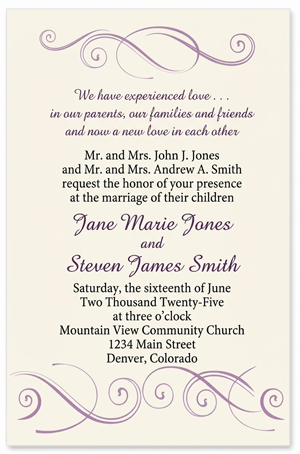
We have experienced love . . . / in our parents, our families and friends / and now a new love in each other / Mr. and Mrs. John J. Jones / and Mr. and Mrs. Andrew A. Smith / request the honor of your presence / at the marriage of their children / Jane Marie Jones / and / Steven James Smith / Saturday, the sixteenth of June / Two Thousand [year spelled out] / at three o’clock / Mountain View Community Church / 1234 Main Street / Denver, Colorado
From the groom’s parents:
Mr. and Mrs. Andrew A. Smith / request the honor of your presence / at the marriage of / Miss Jane Marie Jones / to their son, / Steven James Smith / Saturday, the sixteenth of June / Two Thousand [year spelled out] / at three o’clock / Mountain View Community Church / 1234 Main Street / Denver, Colorado
When the Couple Hosts
Many couples host their own wedding, or host together with their families. When the couple hosts, the invitation names them first and uses “their marriage” instead of “the marriage of their daughter.” Adding “together with their parents” or “together with their families” signals family support without naming every host.
From the bride and groom, with reception following:
In the presence of our loved ones / we will exchange vows of marriage / and pledge to live all our tomorrows / together in love / Jane Marie Jones / and / Steven James Smith / request the honor of your presence / to share in the celebration / of their marriage / Saturday, the sixteenth of June / Two Thousand [year spelled out] / at three o’clock / Mountain View Community Church / Denver, Colorado / Reception to follow / The Victorian at Heritage Square
From the bride and groom and their parents:
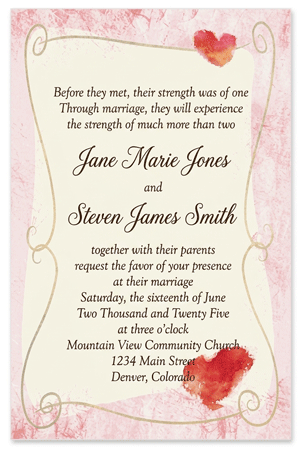
Before they met, their strength was of one / Through marriage, they will experience / the strength of much more than two / Jane Marie Jones / and / Steven James Smith / together with their parents / request the favor of your presence / at their marriage / Saturday, the sixteenth of June / Two Thousand [year spelled out] / at three o’clock / Mountain View Community Church / 1234 Main Street / Denver, Colorado
From the bride and groom and their families:
It is our moment to celebrate / the love that unites us / Together with their families / Jane Marie Jones / and / Steven James Smith / request the favor of your presence / at their marriage / Saturday, the sixteenth of June / Two Thousand [year spelled out] / at three o’clock / Mountain View Community Church / 1234 Main Street / Denver, Colorado
Divorced, Remarried, Blended, and Same-Sex Families
Hosting lines can honor every family respectfully. Etiquette guides suggest a few common approaches, and the right one depends on who is hosting and what feels comfortable to everyone involved. Always confirm how each person wants to be named.
Divorced parents hosting together. List each parent on a separate line, each with their current spouse if you wish: “Ms. Anne Marie Jones / and / Mr. John J. Jones / request the honor of your presence / at the marriage of their daughter / Jane Marie.” Many guides show each parent on a separate line without a shared “Mr. and Mrs.”
One parent hosting. A single host uses the singular verb: “Ms. Anne Marie Jones / requests the honor of your presence / at the marriage of her daughter / Jane Marie.”
Stepparents. If a stepparent is hosting alongside a parent, include them on the hosting line (for example, “Ms. Anne Marie Jones and Mr. Daniel Ortiz”) and consider “the marriage of her daughter” so the relationship is clear.
Same-sex couples hosting. Use the same structure with both names: “Mr. Daniel Brooks / and / Mr. Michael Hayes / request the honor of your presence / at their marriage.” Or “Ms. Jane Marie Jones / and / Ms. Anna Louise Reyes.” Name order is up to you; many couples go alphabetically or in the order that sounds right to them.
Parents hosting a same-sex couple. “Mr. and Mrs. John J. Jones / request the honor of your presence / at the marriage of their daughter / Jane Marie / to / Anna Louise Reyes.” Add the other family if both are hosting.
A single host is simply the person inviting guests — it is not a comment on the rest of the family, and the invitation does not need to explain who is not hosting. The guiding principle is the same in every case: name whoever is actually inviting guests, and keep the wording kind to everyone listed.
The Essential Components of Wording
Every traditional invitation answers the same questions in the same order. Use this breakdown as your checklist:
- Hosts’ names. Who is inviting guests (see above).
- Invitation line. “Request the honor of your presence” or “request the pleasure of your company.”
- Couple’s names. Often “at the marriage of” or “to” between names.
- Date. The day of the week and the date, spelled out.
- Time. Written in words, such as “at half after four o’clock.”
- Location. The venue name, street address, city, and state.
- Reception line (optional). “Reception to follow” or “Dinner and dancing to follow.” Guests should know whether a meal is included.
Clarity and formality matter in every line. Keep each component on its own line, avoid abbreviations, and put extras like directions and accommodations on enclosure cards rather than the invitation itself. Traditional etiquette generally keeps attire off the invitation; if you want to mention it, “Black Tie” on the reception card is the usual place.
One note on phrasing: a common convention is “request the honour of your presence” (many Americans write “honor”) for a ceremony in a house of worship, and “request the pleasure of your company” for a reception or a ceremony at a non-religious venue. Conventions vary, so choose what suits your families, then keep the spelling consistent across the whole suite, including the reply card (“favor” or “favour” of a reply).
Name Order and Titles
Name order is where tradition is most specific — and also where couples most often adapt.
Order of names. Traditionally the bride’s name comes first, then the groom’s, joined by “to” (or “and”). When the bride’s parents are hosting, her name often appears without a surname (“Jane Marie”) because it matches the hosts’, and the groom is listed with his title and full name (“Mr. Steven James Smith”). When the groom’s parents host, the bride is often listed as “Miss Jane Marie Jones” with a note that she is marrying “their son.”
Same-sex couples. There is no fixed rule. Many couples list names alphabetically, or in the order that sounds best, using the same titles and structure as any traditional invitation.
Titles. Use Mr., Mrs., or Ms. before names, and spell out “Doctor” for the most formal look. Military titles follow their own conventions; see our guide to wedding invitation wording for military titles.
Full names. Traditional invitations write out first and middle names rather than initials. Many hosts’ names still appear with a middle initial (as in “Mr. and Mrs. John J. Jones”), so match your hosts’ preference and stay consistent.
Blended families. List each parent and stepparent the way they would like to be named, and use the hosting wording above. When in doubt, ask the people involved.
Titles also matter on the envelope. For addressing guests, see our guide on how to address wedding invitations.
Date and Time Formatting
Traditional invitations spell out the date and time rather than using numerals.
Formal date: “Saturday, the sixteenth of June / Two Thousand [year spelled out].” Years are traditionally written in words, and many guides leave out the “and” (for example, “two thousand thirty,” not “two thousand and thirty”).
Formal time: “at three o’clock” for an on-the-hour start and “at half after four o’clock” for 4:30. Many traditionalists leave out “in the afternoon” or “in the evening” because the hour makes it obvious, while others include them for clarity (as in “at seven o’clock in the evening”). Either is widely used; just be consistent.
Less formal date and time: “Saturday, June 16 at 4:30 p.m.” This is perfectly clear, but it reads as a more casual style.
To avoid common mistakes, double-check the day of the week against the date on a calendar, spell out the month in full, and write times consistently across the invitation, reception card, and any enclosures. If you reuse any sample in this guide, replace the placeholder year and date with your own, and confirm the weekday.
Location Details
Name the venue, then give the street address, city, and state on separate lines. Traditionally the city and state are spelled out and the zip code is left off. Include the full street address if the venue is not widely known, and when the ceremony and reception are in different places, put the reception details on the invitation as a “Reception to follow” line or on a separate reception card.
Directions, maps, parking, and shuttle information are best placed on an enclosure card or your wedding website so the invitation itself stays clean. For ideas on adding a map, consider including a small map card with the envelope.
RSVP and Additional Information
Traditionally, RSVPs are requested with a separate response card or, on the most formal invitations, with “The favor of a reply is requested” and an address. Include a reply-by date and an easy way to respond. If you are using a response card, our essential guide to wedding RSVP wording covers the wording in detail.
Additional information, such as your wedding website, hotel blocks, travel notes, or registry details, belongs on a separate enclosure card rather than on the invitation. Keep the invitation itself focused on the who, what, when, and where. A reception line like “Dinner and dancing to follow” is fine on the invitation because it tells guests what to expect.

Common Mistakes to Avoid
Wording errors are easy to miss because you have read the draft a dozen times. Watch for these:
- Mixing formal and casual language in the same invitation.
- Numerals or abbreviations in a formal date and time.
- A weekday that does not match the date. Check a calendar.
- Inconsistent spelling, such as “honor” on the invitation and “favour” on the reply card.
- Missing titles, or titles that do not match what the person uses.
- Putting gift registry details on the invitation itself.
- Leaving out the reception line, so guests are unsure whether a meal is included.
- Putting too much on one card instead of using enclosures.
Proofread out loud, check every name and title against what the person actually uses, and ask someone who hasn’t seen the draft to read it. Consistency in style and tone is the best sign of a traditional invitation done well.
Bonus: More Traditional Wording Samples for Special Situations
These samples cover destination weddings, receptions, and more contemporary tones, so you can see how traditional structure flexes.
Destination wedding (from the bride’s parents):
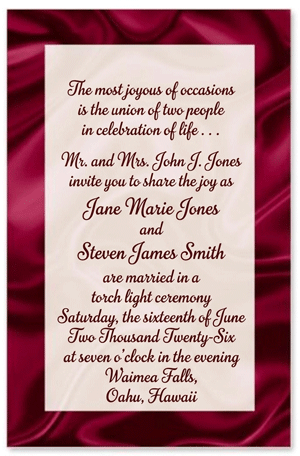
The most joyous of occasions / is the union of two people / in celebration of life . . . / Mr. and Mrs. John J. Jones / invite you to share the joy as / Jane Marie Jones / and / Steven James Smith / are married in a / torch light ceremony / Saturday, the sixteenth of June / Two Thousand [year spelled out] / at seven o’clock in the evening / Waimea Falls, / Oahu, Hawaii
Reception-only invitation:
Love was meant to be shared / with parents, family and friends / Mr. and Mrs. John J. Jones / request the pleasure of your company / at the marriage reception of their daughter / Jane Marie / and / Mr. Steven James Smith / Saturday, the sixteenth of June / Two Thousand [year spelled out] / at seven o’clock in the evening / Mountain View Community Church / 1234 Main Street / Denver, Colorado
Contemporary (from the bride’s parents):
Mr. and Mrs. John J. Jones / invite you to share the joy / as two special people / Jane Marie Jones / and / Steven James Smith / become one in marriage / Saturday, the sixteenth of June / Two Thousand [year spelled out] / at seven o’clock in the evening / Mountain View Community Church / 1234 Main Street / Denver, Colorado
Celebration after a private ceremony (from the bride and groom):
My family, your family — blending as one / Sharing, caring — a new life’s begun / Jane Marie Jones / and / Steven James Smith / are pleased to announce their marriage / on Saturday, the sixteenth of June / during a private ceremony in Hawaii / Please join us for a celebration / when we return as husband and wife / Friday, the twelfth of September at 8:00 p.m. / La Baguette Cafe / Denver, Colorado
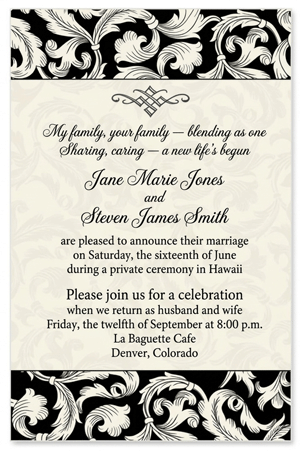
Fun contemporary (from the bride and groom):
His love is the sunshine / that keeps me warm / To me, she’s the rainbow / after the storm / His love gave me wings / it has set me free / And wherever she is / that’s where I want to be / We invite you to be with us / as we begin our new life together / Ms. Jane Marie Jones / and / Mr. Steven James Smith / are pleased to announce / they will be married / Saturday, the sixteenth of June / Two Thousand [year spelled out] / at three o’clock / Mountain View Community Church / 1234 Main Street / Denver, Colorado
The short verses at the top of some samples are optional. Many traditional invitations skip them, and you can swap in a line that suits your own love story, or leave the space for the invitation text alone.
[Insert image here: close-up of a sample invitation with a verse at the top]
Make Your Invitation Wording Your Own
Traditional wedding invitation wording is less about rigid rules and more about showing respect to the hosts, giving guests clear details, and setting a graceful tone for the day. Start with the structure in this guide, adapt the hosting lines to fit your family, and personalize the details while keeping the formal framework. A well-worded invitation is a lasting first impression of your wedding.
Ready to put your wording on paper? Browse PaperDirect wedding invitations or explore formal invitations to find a style that fits your wedding.
FAQ
What is traditional wedding invitation wording?
Traditional wedding invitation wording is a formal, third-person style that names the hosts, uses a phrase like “request the honor of your presence,” lists the couple’s names with titles, and spells out the date and time in words. A typical example is: “Mr. and Mrs. John J. Jones request the honor of your presence at the marriage of their daughter.”
What is the traditional wording for wedding invitations when the bride’s parents are hosting?
The classic structure is: “Mr. and Mrs. [Name] request the honor of your presence at the marriage of their daughter [Bride’s first and middle name] to Mr. [Groom’s full name],” followed by the date, time, and location on separate lines. When the groom’s parents are mentioned, add “son of Mr. and Mrs. [Name]” beneath his name.
Should I write “honor” or “honour” on a wedding invitation?
Both are used. A common formal convention is “request the honour of your presence” for a ceremony in a house of worship, and “request the pleasure of your company” for a reception or non-religious venue. Many American couples use “honor.” Whichever spelling you choose, keep it consistent across every piece of your invitation suite.
How do you write the date and time on a traditional wedding invitation?
Spell both out in words. Write the day, then the date and year, such as “Saturday, the sixteenth of June, [year in words],” and the time as “at three o’clock” or “at half after four o’clock.” Many guides leave out “and” in the year and skip “in the afternoon.” Check the weekday against a calendar.
What if divorced or blended-family parents are hosting together?
List each parent on a separate line, each with a current spouse if applicable, without a shared “Mr. and Mrs.” For example: “Ms. Anne Marie Jones / and / Mr. John J. Jones / request the honor of your presence / at the marriage of their daughter / Jane Marie.” Confirm with each parent how they would like to be named before finalizing the wording.