
Teachers want to recognize their students. That part of the job is easy, and it comes naturally to most educators. The hard part is knowing what to actually write on a certificate. Generic wording like “This certifies that [Name] is awesome” lands with roughly the same emotional weight as a participation ribbon from a grocery store. When a child receives a vague accolade, it usually goes straight into their backpack, never to be seen again. Specific, thoughtful wording is the defining factor that separates a piece of paper a student keeps for years from one they immediately forget.
This post solves the wording problem once and for all. You will leave here with a clear framework for what makes certificate wording effective, along with five ready-to-use, fill-in-the-blank templates you can print and hand out this week. We will also explore creative award category ideas that recognize more than just high test scores, and offer practical guidance on presenting awards certificates for elementary students in a way that actually makes an impact.
Why Certificates Work — and When They Don’t
Recognizing effort and character is directly linked to increased student engagement, self-efficacy, and a willingness to take on new challenges. When you highlight an elementary student’s positive actions, they are far more likely to repeat them.
However, the specificity principle dictates how effective that recognition will be. A certificate that names the exact behavior or achievement being recognized is meaningfully more motivating than a generic one. Even very young students know the difference between a personalized compliment and a blanket statement.
This brings us to the problem of overuse. When every student gets a certificate for everything, the recognition loses its signal value. Selectivity and specificity are what preserve meaning. There are generally two legitimate certificate philosophies in schools today. The first focuses on selective recognition for genuine standout performance. The second uses frequent, low-stakes encouragement certificates deliberately as a motivational tool. Both methods are valid, but they require entirely different wording approaches and distribution strategies.
Finally, the physical quality of the certificate affects its perceived value. A well-designed document printed on high-quality paper signals that the award was taken seriously. Thin copy paper undercuts even the most excellent wording. Thoughtful text, meaningful categories, and a strong format work together to make an elementary certificate truly special.
What Every Elementary School Certificate Should Include
Every award certificate for elementary students must contain a few core elements to be effective. Leaving these out diminishes the importance of the recognition.
Student’s full name
Use the student’s preferred name, not just the legal name on your class roster. Getting a child’s name right—including spelling and pronunciation at the ceremony—is the most basic form of respect your certificate can convey. For young students especially, seeing their own name printed clearly on an official-looking document carries real weight.
Reason for the award
This is the most important field on the certificate and the one most often handled poorly. “For outstanding achievement” tells the student nothing. “For helping a classmate learn their multiplication tables every day this week” tells them exactly why they are being celebrated. The reason field should name the specific behavior, project, improvement, or contribution being recognized.
Teacher, classroom, or school name
This establishes the legitimacy of the award and anchors it to a specific time and place. You can place this information at the bottom of the certificate for a cleaner visual hierarchy without losing its function.
Date
A dated certificate becomes a time-stamped memory. Students and parents can look back at it years later and know exactly when it happened. For improvement certificates especially, the date is a crucial part of the story.
Signature
A handwritten signature from the teacher transforms a printed document into a personal artifact. Even early elementary students understand that a physical signature means someone truly meant what was written.
Optional: A brief personalized note
A single handwritten sentence in the margin or on the back of the certificate dramatically increases its emotional staying power. Write something only you could have noticed about that specific student. It takes thirty seconds and is worth every single one of them.
Ready-to-Use Certificate Wording Templates for Elementary Students
Here are five fully developed, immediately usable fill-in-the-blank templates covering the most common recognition scenarios.
Student of the Week
When to use: Weekly rotating recognition that keeps every student in contention regardless of their academic level.
Template: “This certificate is proudly presented to [Student Name] for [specific reason] in [Teacher Name]’s class at [School Name]. We’re proud of you.”
Guidance note: The reason field is everything here. “Being a great student” is not a reason. “Teaching three different classmates how to log into the reading program without being asked” is a reason.
Certificate of Excellence
When to use: Subject-specific recognition for outstanding performance or a genuinely exceptional piece of work.
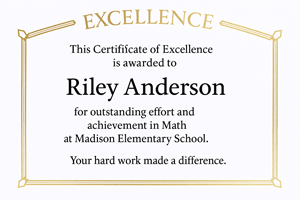
Template: “This Certificate of Excellence is awarded to [Student Name] for outstanding effort and achievement in [Subject] at [School Name / Classroom]. Your hard work made a difference.”
Guidance note: Reserve this for genuine standout work, not general competence. The word “excellence” loses meaning fast if you distribute it broadly.
When to use: Marking the successful completion of a specific task, project, unit, or milestone.
Template: “You Did It! This certificate is presented to [Student Name] for successfully completing [specific task, project, or activity] in [Classroom / School]. Your effort and dedication paid off.”
Guidance note: This works especially well for multi-week projects or skills that required sustained effort. The celebratory opener matches the energy of finishing something hard.
Certificate of Improvement
When to use: Recognizing meaningful progress relative to a student’s own baseline. This is one of the most powerful and underused certificate types.
Template: “Way to Go! This certificate is presented to [Student Name] for remarkable improvement in [Subject or Skill]. Your growth in [Classroom / School] has been noticed and celebrated.”
Guidance note: This certificate is most meaningful when paired with a specific observation. “You went from reading 10 words per minute to 28 in six weeks” is vastly more powerful than “great improvement in reading.”
Graduation / Grade Completion Certificate
When to use: End-of-year recognition marking the successful completion of a grade level.
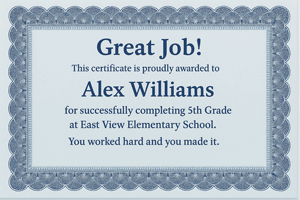
Template: “Great Job! This certificate is proudly awarded to [Student Name] for successfully completing [Grade Level] at [School Name]. You worked hard and you made it.”
Guidance note: This is one of the highest-stakes award certificates for elementary students. Many students keep this one forever. Quality paper matters more here than anywhere else on this list. Print this on your absolute best stock.
Creative Award Categories Beyond Academics
Most elementary recognition programs cover academic achievement heavily, but overlook other crucial areas of development. Recognizing character, creativity, community, and effort gives every student a chance to shine. Develop these categories with specific, observable behaviors so you can identify recipients confidently.
Character & Social Awards
- Faithful Friend Award: For the student who consistently includes others or goes out of their way for a peer. Name specific observable behaviors, like inviting a new student to sit with them at lunch.
- Kindness Champion Award: Recognizes students who model kindness as a consistent habit across multiple contexts—toward classmates, staff, and in how they handle frustration.
- The [School Name] Peace Prize: For the student who de-escalates conflicts before they become major incidents. Acknowledge that this skill is genuinely rare at any age.
Effort & Growth Awards
- Excellent Effort Award: Explicitly decoupled from grade outcomes. This goes to the student who worked the hardest, not the one who scored the highest.
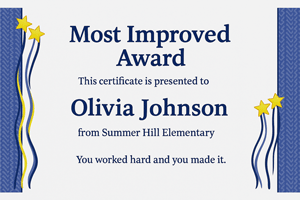
- Most Improved Award: Recognizes measurable growth relative to the student’s own baseline. Pair the certificate with a private note naming the actual growth observed.
Creativity & Curiosity Awards
- Classroom Creativity Award: For work that goes genuinely beyond the prompt. Think of the illustration that surprised everyone or the science hypothesis nobody else thought of.
- Walking Encyclopedia Award: For the student whose curiosity and knowledge spans well beyond the current unit. Intellectual enthusiasm is its own form of academic engagement.
Community & Classroom Awards
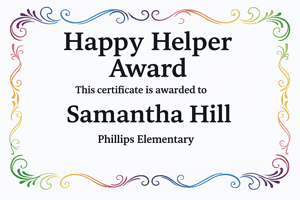
- Happy Helper Award: For the student who volunteers first and helps without being asked. Recognizing helping behavior publicly tends to increase helping behavior across the entire class.
- School Spirit Award: For the student who shows up with energy and lifts the mood of the room. This is particularly effective for students who aren’t typically in the academic spotlight.
You can also adapt these for seasonal themes, like a “Fresh Start Award” in the fall or a “Spring Momentum Award” later in the year. Furthermore, allowing simple peer nominations often produces highly specific, emotionally resonant award language.
Design and Presentation — Making the Certificate Feel Like an Award
A certificate’s design and the moment of its presentation are just as important as the wording. Elementary award certificates should look and feel official.
Color and visual tone matter heavily. Bright, cheerful colors and age-appropriate graphics signal celebration in a way a plain white document simply doesn’t. Choose fonts that balance legibility with a bit of visual personality. Avoid pure utility fonts that make the certificate look like a tax form.
The student’s name should be the largest, most prominent text element on the page. Simple graphic elements like a star or a border do plenty to make a certificate feel celebratory. Restraint is key; visual clutter undercuts legibility. Finally, use quality certificate paper stock. Matte parchment or a textured stock reads as “official,” while standard copy paper feels cheap.
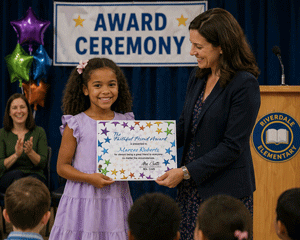
When presenting certificates for elementary students, state the child’s name clearly and correctly. Lead with the specific reason before handing over the certificate. Saying, “This award goes to Sarah because last Tuesday she…” builds a story before the handover. For classroom presentations, keep things brief, warm, and specific. A 45-second acknowledgment in front of peers is vastly more meaningful than a five-minute speech.
After the ceremony, encourage students to display their certificates on classroom bulletin boards, and send a brief note home encouraging parents to find a spot for it on the fridge.
The True Value of Thoughtful Recognition
A certificate is only as meaningful as the thought behind it. The templates and categories provided here give you a strong starting point, but the most powerful certificates will always be the ones where a teacher took sixty extra seconds to name the specific thing that only that student did. Certificates do not require a massive school-wide program to matter. They require intention, good paper, and a teacher who noticed.
You have the wording. Now make it official. PaperDirect’s certificate and award paper is designed for exactly this purpose—professional, print-ready stock that makes every certificate feel like it was meant to be kept. Browse the collection today and have recognition-ready paper on hand before your next moment worth celebrating.