

There was a specific feeling that came with back-to-school shopping in the 1990s, and it had almost nothing to do with being prepared for class. Stepping into the fluorescent-lit aisles of a local big-box store meant making crucial decisions about your identity. The supplies you chose telegraphed exactly who you were, which lunch table you belonged to, and how seriously you took the business of being a kid. We didn’t buy folders to hold loose-leaf paper. We bought them to make a statement.
This is a tribute to the 90s school supplies that made that era unforgettable. These items were fashion statements, cultural artifacts, and vital pieces of social currency. Let’s take a look back at the 90s stationery and classroom gear that defined a generation.
The Trapper Keeper — Status Symbol, Identity Document, Personal Brand HQ
Introduced by Mead in 1978, the Trapper Keeper reached its absolute cultural peak in the late 1980s and throughout the 1990s. By the early 90s, it reigned as a classroom status symbol with no real functional competitor.
The pattern on the cover was a deliberate choice that communicated your personality, interests, and social affiliations before you even said a single word. Geometric patterns, neon nature scenes, airbrushed gradients, and licensed character art were all heavily in play. You chose a design to signal your vibe.
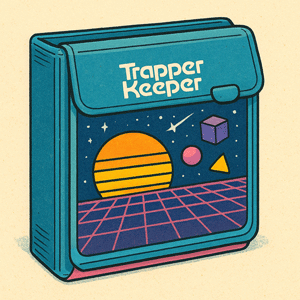
Applying stickers to the front and back cover functioned as the 90s equivalent of a social media profile. It offered a curated, constantly evolving public display of what you cared about. The Trapper Keeper was the canvas, and the stickers were the content. Even the satisfying Velcro or snap closure became a social feature. Opening and closing it during a quiet class was a minor form of self-expression, occasionally earning a swift reprimand from an irritated teacher.
Virtually every American kid of a certain age wanted one. That universality eventually led to the product’s downfall, as schools began banning Trapper Keepers in the early 2000s due to their bulk and how they disrupted organized desks. Naturally, the ban itself became part of the mythology. Mead has periodically reissued them for the adult nostalgia market, but nothing quite matches the magic of the original run.
Lisa Frank — The Artist Who Made Every School Supply a Maximalist Statement
Lisa Frank is both a real person, born in 1955 in Tucson, Arizona, and the iconic brand she founded in 1979. Her company became famous for hyper-saturated, maximalist designs featuring rainbow-colored animals, fantasy creatures, and impossibly vivid color combinations.
Neon dolphins, rainbow tigers, and unicorns on roller skates dominated the aesthetic. The defining characteristic of Lisa Frank designs was their operation at a color and whimsy level that felt genuinely impossible. They looked more saturated than real life, bringing profound joy to the school supply aisle.

Her reach extended across virtually every category, including folders, notebooks, binders, pencil cases, erasers, and 90s stationery paper. If a design could be printed on it, Lisa Frank did it. Owning the right items—especially the holographic folders and the sticker sheets—provided massive social currency, predominantly among girls. Trading Lisa Frank stickers created a bustling micro-economy.
The puffy stickers, in particular, occupied a prestigious tier that required specific social permission to actually use. Thanks to a significant nostalgia revival in the 2010s and 2020s, Lisa Frank designs have appeared in adult fashion collaborations and home goods, proving that the visual identity remains fiercely distinctive.
The Trapper Keeper’s Quieter Cousin — Five Star Notebooks for the Serious Kid
Avery Dennison’s Five Star brand has been manufacturing spiral notebooks since 1939. However, the five-subject notebook format became a true 90s classroom staple because it offered the most organizationally serious option available to students who weren’t yet using binders.
If a vibrant binder signaled a focus on aesthetics, the Five Star notebook communicated that you had a strict system. These represented genuinely different social identities in the classroom. The color-coding system—one notebook per subject, one color per subject—was a hallmark of the conscientious 90s student. Picking your colors at the start of the school year evolved into a ritual carrying its own low-stakes anxiety.
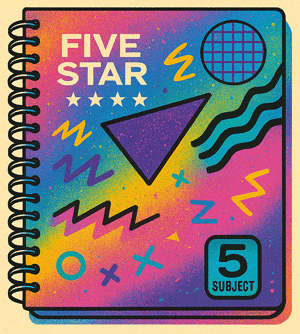
Physical details defined the product. The impressive durability compared to standard composition notebooks, the poly covers that resisted bending, and the perforated pages designed to tear cleanly felt deeply meaningful when you were twelve years old. Today, Five Star notebooks are still widely available and essentially unchanged, holding their ground as a reliable classic. Owning one showed you took the academic project seriously, which could be seen as highly aspirational, slightly dorky, or a perfect mix of both.
Gel Pens and Push-Up Pens — Writing Instruments for Pure Aesthetics
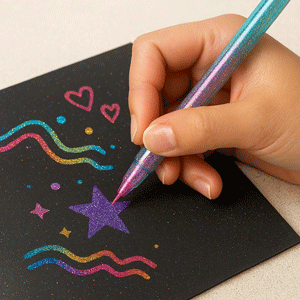
Gel pens arrived in the US market in the mid-1990s, led by the Sakura Gelly Roll and quickly joined by Pentel, Paper Mate, and others. The ink, suspended in a water-based gel rather than oil, allowed kids to write smoothly on dark paper. Metallic and glitter gel pens leaving visible marks on black construction paper felt almost magical to a 90s kid.
These pens existed for notes passed in class, decorating folders, or writing in journals using colors that matched your exact mood. You definitely didn’t use them for math homework. A strict color hierarchy dictated their value: glitter reigned supreme, followed by metallic, neon, and finally standard colors. Owning the full Gelly Roll set served as a major status event.
Meanwhile, push-up multi-color pens highlighted a funny generational divide. Single-color pens were for parents; massive, cigar-thick multi-color pens were for kids. A color selector sat visible through a clear panel, and pushing down the right color required a specific practiced motion.
Functionally, these pens failed constantly. The ink dried out, the color selectors jammed, and nobody cared. Having the pen was the entire point. Switching colors between notes in class became a minor performance, showing everyone that you cared deeply about which ink color matched which subject.
Pencil Grips and Standalone Erasers — Accessories Nobody Needed but Everyone Wanted
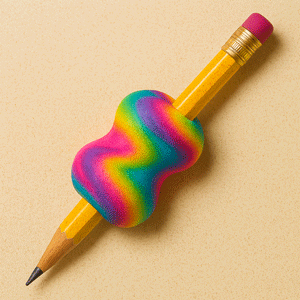
The 90s accessory ecosystem proved that kids were remarkably willing to assign aesthetic value to objects with almost zero functional purpose. Ergonomic pencil grips originally launched to help young writers with grip pressure and letter formation. Somehow, this legitimate occupational therapy tool morphed into a mandatory fashion accessory.
The grip was often the single customizable element on an otherwise plain yellow pencil. Kids meticulously coordinated their Stetro grips and standard triangular foam grips with their outfits and binders. Most students using them did not need them ergonomically, but they desperately needed them aesthetically.
Similarly, standalone erasers existed primarily to be collected and displayed. They came in every conceivable shape, from food items and animals to cartoon characters and geometric novelties. The variety meant everything; the erasing was purely incidental. Favorites lived inside the pencil bag, which functioned as a curated exhibition space opened frequently for public viewing.
When you did attempt to use a cute standalone eraser, you usually ended up smearing low-grade rubber across the page. Scratch-and-sniff erasers occupied their own specific tier of prestige, rewarding anyone lucky enough to find a good one.
The Sticker Economy — Currency, Collection, and Strategic Placement
Stickers formed the through-line of the entire 90s school supply ecosystem. They covered binders, pencil bags, erasers, and every available surface of personal property. They acted as tradeable, giftable, and hierarchically valued social currency.
A rigid sticker tier system governed the classroom:
- Scratch-and-sniff: High prestige, offering sensory novelty you could identify by smell before even seeing the design.
- Puffy/3D stickers: Elevated by their tactile dimension, feeling thicker and looking far more prominent.
- Holographic/prismatic stickers: The absolute apex of the 90s sticker hierarchy. These color-shifting beauties were precious enough that applying them required immense consideration.
- Standard flat stickers: The baseline currency, used freely because losing one was entirely survivable.
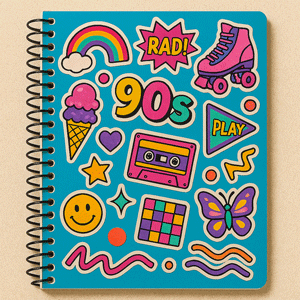
Where you placed a sticker required strategy. Front cover placements served as public declarations, while inside-folder stickers remained private. The very best stickers from brands like Sandylion often went unused due to the “too good to use” phenomenon. Using a sticker meant losing it forever, so serious collectors kept dedicated sticker books. These books functioned as both display cases and trading inventories, representing the most committed form of 90s sticker culture.
Bring That Same Energy to Your Desk Today
Turns out the kid who color-coded their Five Star notebooks and collected stationery 90s style grew up to be the adult who cares about what their business stationery says about them. The impulse remains exactly the same. You just happen to have a slightly larger budget and a valid tax deduction now.
Paper Direct’s business stationery and specialty paper selection is designed for exactly that person. Whether you need sleek certificates, custom presentation folders, or high-quality letterheads, we have the modern upgrades you are looking for. Browse our complete stationery collection and bring a little of that old Trapper Keeper energy to your desk today.