
Knowing how to address wedding invitations correctly is one of the quickest ways to show guests that their invitation was prepared with care. The envelope is the first thing they see, and a few simple conventions—who is named, which titles to use, and what goes on the inner and outer envelopes—keep it polished.
This guide covers the traditional rules, the modern variations, and how to handle trickier guest lists, from couples with different surnames to children and plus-ones. When you’re ready to assemble your set, browse PaperDirect’s wedding envelopes and wedding invitations.
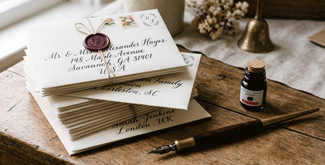
Understanding the Basics of Wedding Invitations
The way you address an invitation should match how formal the wedding is. Etiquette is a guide, not a test, so use the level that fits your event and your guests.
- Formal: Traditional wording, full names with titles, handwritten or calligraphed envelopes, and usually an inner and an outer envelope.
- Semi-formal: Mostly traditional addressing, with room for modern touches such as a single envelope or a printed label.
- Casual: Relaxed wording and often first names on the envelope (for example, “Sarah and Mike Lopez”).
A standard invitation carries the host line, the couple’s names, the date and time, the ceremony location, and usually a reception detail and a response card. Whatever you choose, keep the envelope in step with the invitation: a formal invitation looks best with a formally addressed envelope. Browse the wedding invitations collection to find a style that fits your event.
Choosing the Right Envelope
Choose your envelopes before you start addressing, because the size, color, and finish affect how easy they are to write on and mail. Pick a size that fits your invitation suite with a little room to spare, and order extras for mistakes and for guests you add later.
A few practical points:
- Fit the suite. Place the invitation, response card, and any enclosures inside before you commit. A standard 5 x 7 inch card, for example, is commonly paired with an A7 envelope.
- Match the theme. White, ivory, and soft neutrals suit traditional weddings, while color, metallics, or liners work for modern or themed events. Envelope liners and envelope seals are an easy way to carry your colors onto the outside.
- Check the writing surface. Dark or textured envelopes can be hard to read in regular ink. Test your pen, or use a metallic or white ink, before you address them all.
- Check postage. Square, thick, or rigid envelopes can cost more to mail. Take a fully assembled invitation to the post office to have it weighed before you buy stamps.
PaperDirect’s wedding envelopes collection is a good place to start.
Addressing the Outer Envelope
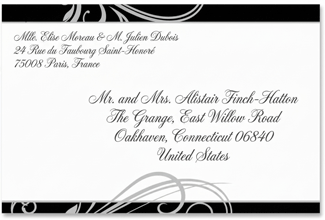
In short: the outer envelope carries the full names of the invited adults, with titles, plus the mailing address. Children’s names and “and Guest” belong on the inner envelope. Use these guidelines for names, titles, and addresses:
Use formal names. Use full given names rather than nicknames. Etiquette sources generally skip middle initials, but a full middle name is fine on a very formal invitation if you want to include it. Whatever you choose, be consistent across the whole guest list.
Use titles. Mr., Mrs., Ms., Dr., and Jr. are the usual abbreviations. If you aren’t sure whether a woman prefers Mrs. or Ms., Ms. is the safer choice. For a guest who uses “Mx.,” use that title. When in doubt, ask the guest or a family member.
Spell out the rest. Write out words such as Street, Avenue, Apartment, and Boulevard, and spell out state names, so a formal address reads as “543 South Maple Street, Denver, Colorado.” Some etiquette sources allow postal abbreviations for states, so choose one approach and stick with it. Keep the ZIP code in numerals.
Address both members of a couple. Invite both people, even if you only know one of them well. Married couples who share a surname are traditionally addressed as “Mr. and Mrs. Michael Morris,” but many couples prefer both first names, such as “Mr. Michael Morris and Mrs. Susan Morris.” Use whichever style the couple would choose.
Write it clearly. Handwriting or calligraphy is the traditional choice. Printed labels are widely used today and are most convincing on semi-formal and casual invitations. If you go this route, a clean design such as wedding address labels keeps the envelope looking intentional.
Titles That Need Special Handling
- Doctors: “Dr. Henry Anderson and Mrs. Susan Anderson” is typical when one spouse is a doctor. When the woman is the doctor, list her title first: “Dr. Rachel Chen and Mr. David Chen.” When both are doctors, use “Drs. Rachel and David Chen.” Dr. is the common abbreviation, but very formal invitations sometimes write out “Doctor,” so keep it consistent.
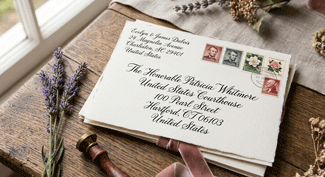
- Judges: “The Honorable Patricia Whitmore” is the traditional outer-envelope form, with “Judge Whitmore” on the inner envelope. Some hosts simply write “Judge Patricia Whitmore.”
- Military guests: Spell out the rank and put it before the name, for example “Captain James Hollis.” The branch of service is often added on the next line. On the inner envelope, use the rank and surname: “Captain Hollis.” For more on this, see our guide to wedding invitation wording for military titles.
- Generational suffixes: Abbreviate “Jr.” and use it only with the full name, as in “Mr. Robert Smith Jr.”
Titles vary a little between etiquette sources, so treat the examples above as the common approach and ask the guest when you’re unsure.
Addressing the Inner Envelope
The inner envelope is a second, unsealed envelope tucked inside the outer one. Its job is to show exactly who is invited, which is especially useful for children and guests. Many modern couples skip it, which is fine. If you do use one, write the names this way:
- Formal style: Use the title and surname only: “Mr. and Mrs. Miller.”
- Closer relationships: First names are fine for relatives and close friends: “Aunt Susan and Uncle David.”
- Children: List the first names of invited children on a line below their parents: “Mr. and Mrs. Miller,” then “Emma and Jack.”
- Single guests: Use the guest’s title and surname, and add “and Guest” only if they may bring someone whose name you don’t know: “Ms. Taylor and Guest.”
If you skip the inner envelope, make sure the outer envelope names everyone who is invited, and mention any children on the line below their parents. Use first names when the relationship is friendly and the wedding is relaxed, and full names with titles when it is formal.
Wording the Invitation
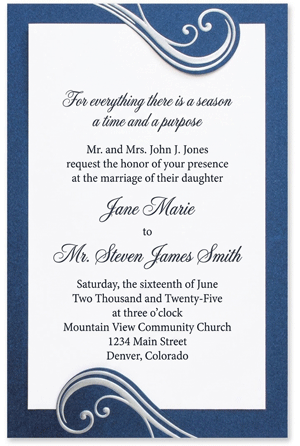
Addressing and wording go together, so the language inside the envelope should match the style on the outside. Traditional invitations use formal phrasing such as “request the honour of your presence” (often used for ceremonies held in a house of worship) or “request the pleasure of your company” for other venues. Modern invitations use warmer, simpler language like “Join us as we celebrate.”
To convey formality, spell out the date and time in words, write names in full, and avoid abbreviations and symbols. Include the details guests need to respond: an RSVP date, a response card or website, and any extra information such as a reception location. For response-card wording, see PaperDirect’s wedding response sets.
Return Address Etiquette
Traditionally, the return address is printed or written on the back flap of the outer envelope. A return address in the upper left corner of the front is also common and is easy for postal workers to read, so either placement is acceptable. Formal invitations usually show the address without names, though that is a style choice.
Always include a return address. It lets the post office return any undeliverable invitations and gives you a way to find out about outdated addresses. Also remember that the return address on the outer envelope is not the same as the address on your response-card envelope: the response card should be addressed to whoever is collecting RSVPs, which may be a host or a family member rather than the couple. A pre-stamped, pre-addressed response envelope makes it easy for guests to reply.
How Do You Handle Special Guest List Situations?
Modern guest lists rarely fit a single pattern. These are the situations people ask about most. Etiquette sources don’t always agree on the details, so when in doubt, ask the guests how they prefer to be addressed.
- Couples with different surnames: List both full names on one line, joined by “and,” with the order of your choice: “Ms. Rachel Goldstein and Mr. David Chen.”
- Same-sex couples: Use each person’s full name and title, for example “Mr. James Hollis and Mr. Alexander Hollis” or “Ms. Claire Bennett and Ms. Rachel Chen.” Either order is fine, and alphabetical by first name is a neutral default.
- Unmarried couples at the same address: Write both names on separate lines in alphabetical order, or on one line joined by “and.” The point is that each person is named. Do not use “Mr. and Mrs.”
- Single guests and plus-ones: Address the outer envelope to the person you are inviting. If you know the guest’s partner or date, invite them by name. Reserve “and Guest” for the inner envelope, and only when you don’t know the plus-one’s name.
- Children: Children under 18 are traditionally named on the inner envelope under their parents. Guests 18 and older typically get their own invitation. If children aren’t invited, address the envelope to the adults only, and share that information through your wedding website or word of mouth rather than printing it on the envelope.
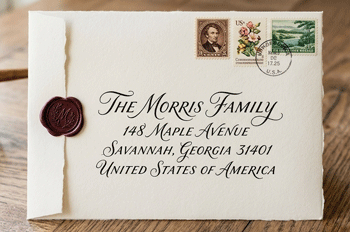
- Whole households: The phrase “and Family” is considered informal for a formal invitation. Listing each person’s name is more traditional, but “The Morris Family” works for casual weddings when everyone in the household is invited.
- Divorced or remarried parents: If divorced guests live at different addresses, send each one a separate invitation. Address each to their own name as they prefer, such as “Ms. Susan Miller,” or with their new partner’s name if they have remarried.
- Widowed guests: Use the form the guest prefers, for example “Mrs. David Miller” or “Ms. Susan Miller.”
Common Mistakes to Avoid
Most addressing mistakes are small, but they are the ones guests notice. Watch for these:
- Using nicknames or leaving out titles on a formal invitation.
- Assuming every couple is “Mr. and Mrs.” or that a married woman uses her spouse’s surname.
- Writing “and Guest” on the outer envelope instead of the inner envelope.
- Using “and Family” when you haven’t decided who in the household is invited.
- Abbreviating street names, directions, or state names on a formal invitation.
- Forgetting the return address or the postage for an oversized envelope.
- Misspelled names or mismatched addresses. Check your guest list against your master spreadsheet.
Before sending, proofread every envelope, ask a second person to check the list, and mail one fully assembled test invitation to yourself. It will show you the postage, the way your handwriting or labels look, and whether the envelope holds up in the mail. Practice on a spare envelope first, and order a few extras.
Final Thoughts: Addressing Wedding Invitations With Confidence
Addressing wedding invitations is mostly about care: use full names, the right titles, spelled-out addresses, and a clear note of who is invited. Where etiquette sources differ, choose the approach that fits your wedding and your guests, and stay consistent from the first envelope to the last. Done well, the envelope sets the tone before guests ever open it.
Ready to assemble your invitations? Shop PaperDirect wedding envelopes, finish them with wedding address labels, and browse our wedding invitations collection.
FAQ
How do you address a wedding invitation to a couple with different last names?
Write both full names on one line, joined by “and,” with titles: “Ms. Rachel Goldstein and Mr. David Chen.” Either name can come first, and alphabetical order is a neutral default. Use the same format for same-sex couples. If you’re unsure how a couple prefers to be addressed, ask them or a close family member.
Do you still need an inner envelope for wedding invitations?
No. Inner envelopes are a traditional, formal touch, not a requirement, and many modern couples skip them. If you do use one, it goes inside the outer envelope unsealed and lists exactly who is invited, including children. Without one, make sure the outer envelope clearly names everyone invited.
How do you address wedding invitations with “and Guest”?
Address the outer envelope to the invited person only, such as “Ms. Taylor Brooks.” Then write “Ms. Brooks and Guest” on the inner envelope, so it is clear the guest may bring someone. If you know the name of the person’s partner or date, write it in instead and skip “and Guest.” Use “and Guest” only when you don’t know who they’ll bring.
How do you address wedding invitations to a family with children?
Write the parents’ names on the outer envelope, such as “Mr. and Mrs. Michael Morris.” On the inner envelope, add the first names of invited children on a line below. Children 18 and older typically get their own invitation. For casual weddings, “The Morris Family” works if everyone in the household is invited.