
A wedding program does two jobs at once. It guides your guests through the ceremony, and it becomes a keepsake they take home. Getting your wedding ceremony program wording right means choosing what to include, putting it in the right order, and keeping the tone in step with the rest of your wedding.
There are no strict rules here, but there are traditional conventions that most programs follow, and knowing them makes the writing process much easier. This guide covers what to include, sample wording you can adapt for your own ceremony, and how to design and print the finished piece. Once your text is written, PaperDirect’s wedding ceremony programs are a ready place to bring it to life.
The Basics of Wedding Program Wording
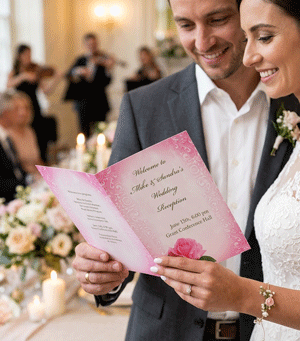
A wedding program is a printed—or digital—guide to your ceremony. It lists the order of events and the people taking part, so guests know what is happening and who is who. Many guests keep it as a souvenir of the day, which is exactly why it’s worth getting the wording right.
Your program should carry the same feel as the rest of your wedding. It should add to the ceremony, not pull attention away from it. Since there are no set rules for what must be included or how the wording is organized, the lists below cover the traditional elements most programs use. Take what fits your ceremony and leave the rest.
Two principles guide good wedding program wording:
Personalization. Match the voice to your ceremony. A formal program might read “Processional,” while a relaxed one might say “Everyone, please welcome the wedding party.”
Clarity. Use plain headings and short lines. Guests should be able to follow along at a glance, even in low light.
What Should Go on a Wedding Program Cover?
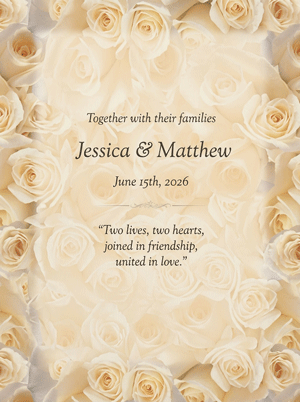
Start with the cover, which should tell guests exactly which ceremony they are attending. The cover can include:

- The full names of the couple
- The wedding date, including the year, and the time
- The ceremony location
A short line such as “Together with their families, [Name] and [Name] invite you to celebrate their marriage” can sit below the names.
For formal wedding program wording, keep the cover simple: names, date, time, and place, with nothing else competing for attention. Add the city and state if guests are traveling from out of town.
How Do You List the Wedding Party in a Program?
List everyone who is taking part in the ceremony, usually in the order they appear or by rank of role. Include the roles that apply to your wedding:
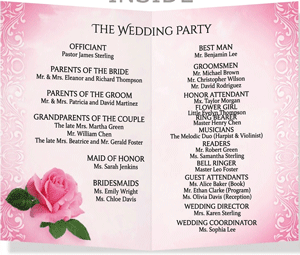
- Officiant
- Parents of the couple
- Grandparents of the couple
- Maid, matron, or honor attendants
- Bridesmaids and groomsmen (or attendants on both sides)
- Flower girls and ring bearer
- Best man (or best person)
- Musicians and readers
- Bell ringer, if applicable
- Guest book, program, and reception attendants
- Wedding director or coordinator
Special mentions, such as honoring parents, grandparents, or loved ones who could not attend, can go in a short note near this list. Always confirm the spelling and title of each person with the couple before printing—a typo in a name is hard to unsee in a keepsake.
Sample layout:
Officiant: [Name]
Maid of Honor: [Name]
Best Man: [Name]
Bridesmaids: [Name], [Name], [Name]
Groomsmen: [Name], [Name], [Name]
Flower Girl: [Name]
Ring Bearer: [Name]
What Is the Typical Order of Events in a Wedding Program?
This section is the heart of the program, and the part most guests read closely. A traditional ceremony may follow an order like this one, keeping only the parts that apply to your day:
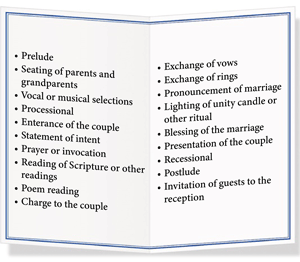
- Prelude
- Seating of parents and grandparents
- Vocal or musical selections
- Processional
- Entrance of the couple
- Statement of intent
- Prayer or invocation
- Reading of Scripture or other readings
- Poem reading
- Charge to the couple
- Exchange of vows
- Exchange of rings
- Pronouncement of marriage
- Lighting of unity candle or other ritual
- Blessing of the marriage
- Presentation of the couple
- Recessional
- Postlude
- Invitation of guests to the reception
Special rituals or traditions, such as a unity candle, sand ceremony, handfasting, or a cultural or religious custom, deserve a line or two so guests understand what they are watching. For example:
“Unity Candle. The couple lights a single candle as a symbol of two lives joined as one.”
Sample of wedding ceremony program wording for a formal ceremony:
Prelude, Processional, Welcome, Reading ([Reader’s name]), Exchange of Vows, Exchange of Rings, Pronouncement of Marriage, Recessional.
How Do You Write Acknowledgments and Thank-Yous for a Program?
A short thank-you note is one of the most common optional additions. Use it to recognize the family and friends who helped, and to mention any special guests or loved ones. Keep it brief, warm, and specific.
- Special thanks: “Thank you to our families and friends for the love and support that brought us here today.”
- Dedication: “We dedicate this day to [Name], who is with us in our hearts.”
- Special guests: Name anyone traveling a long way or serving in a meaningful role.
What Personal Touches Can You Add to a Wedding Program?
Optional extras make the program feel like yours. Popular choices include:
- A poem, quote, or song lyric that is meaningful to the two of you. See 10 Quotes for Wedding Ceremony Programs for ideas.
- A short history of your relationship or a few fun facts about the couple.
- Directions to the reception venue, so guests don’t need to look them up.
- Your new home’s address, if you’d like guests to send cards there.
- A brief welcome message from the couple.
Keep each extra short. A program with one or two meaningful additions reads better than one stuffed with everything you could think of.
What Design Choices Make a Wedding Program Easy to Read?
The wording only works if people can actually read it. Choose a legible font for the main text, and save decorative scripts for the names on the cover. Use two or three fonts at most, and make sure the ink color has strong contrast against the paper.
Colors and graphics should echo your invitations and wedding theme, so the whole stationery set feels connected.
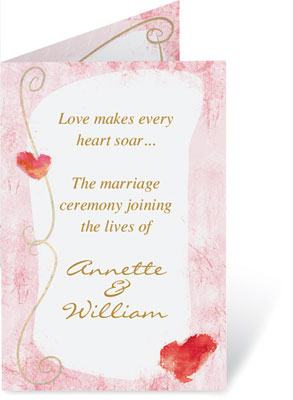
Format matters too:
- A single flat card suits a short ceremony.
- A folded program has room for a full order of events.
- A tri-fold gives you even more panels for extra details.
Browse PaperDirect’s Wedding Brochures & Tri-Fold Programs for multi-panel layouts, and see Wedding Program Paper Options for more on choosing the right paper.
Should You Choose a Digital or Printed Wedding Program?
Printed programs are the traditional choice, and many couples still prefer them as keepsakes. Digital programs can work well as an addition rather than a replacement. Here is how they compare:
- Printed pros: Guests can hold them, they double as keepsakes, and they need no phone or signal.
- Printed cons: They take time to design and print, and changes after printing are hard to make.
- Digital pros: Easy to update, shareable, and able to hold extra details, such as a longer story or photos.
- Digital cons: Guests need a device and connection, and many people won’t look at it during the ceremony.
Best of both: Print a short program and add a QR code or web link to a longer version online with extra details, such as the reception schedule.
If your date is close and you’re short on time, Last Minute Wedding Programs! is worth a look for tips on getting programs done quickly.
What Mistakes Should You Avoid When Writing a Wedding Program?
- Overloading with information. Too much text makes a program hard to scan. Keep wording short and leave white space.
- Skipping the proofread. Check every name, title, date, and time, and ask someone who didn’t write it to read it too.
- Wrong order of events. Confirm the order with your officiant so the program matches what actually happens.
- Forgetting someone. Review the wedding party and thank-you lists against your guest and family plans.
- Printing before final approval. Print one test copy first to check alignment, spacing, and readability.
FAQ
What should be included in wedding ceremony program wording?
Most programs include the couple’s names, the date, time, and location, then the order of events and the wedding party. Many also add a thank-you note, a dedication, or a meaningful poem. There are no strict rules, so include what helps guests follow the ceremony and leave out anything that makes the program feel crowded.
What is the proper wording for a formal wedding program?
Formal wedding program wording keeps a traditional tone and standard terms, such as Prelude, Processional, Exchange of Vows, Exchange of Rings, Pronouncement of Marriage, and Recessional. List the couple’s full names on the cover, give titles to the wedding party, and use simple headings. Ask your officiant to confirm the order before printing.
Can I use a sample of wedding program wording and customize it?
Yes. A sample is a good starting point, and most couples adapt the wording to their ceremony. Replace the names and roles, delete any parts of the order of events you won’t use, and add personal touches such as a quote or a note of thanks. Proofread the final version before you print.
Make Your Wedding Program One Guests Will Keep
A well-crafted wedding program guides your guests through the ceremony and gives them something to remember it by. Take time with the wording, check every name and detail, and make it reflect you as a couple. Whether it’s a simple card or a full tri-fold, a thoughtful program helps guests feel part of the day.
Ready to put your wording into print? Browse PaperDirect’s wedding ceremony programs and tri-fold wedding programs to find the format that suits your ceremony.