
Wedding programs have long helped guests follow along during the ceremony. They show the sequence of events, name the people taking part, and give everyone a keepsake of the day. Getting your wedding ceremony program wording perfect also keeps your etiquette in order. This guide walks through the purpose of a program, what to include, how to choose a tone, sample wording you can adapt, and how to print it. Once your text is written, PaperDirect’s wedding ceremony programs are a ready place to start.
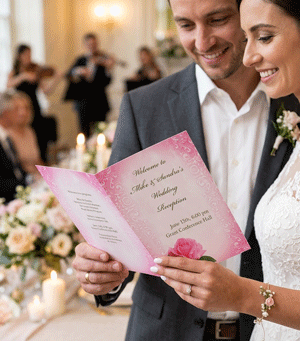
Understanding the Purpose of Wedding Programs
A wedding program is a printed (or digital) guide to your ceremony. It does three jobs:
- It guides guests. The order of events tells people what is happening and what comes next, so no one is left guessing during an unfamiliar ritual or reading.
- It recognizes people. It names the officiant, family, attendants, and musicians who are part of your day.
- It becomes a keepsake. Many guests take the program home, so it helps them memorialize the day.
Good wedding program wording also sets the tone. A clear, well-ordered program tells guests the ceremony is thoughtfully planned before the music even starts. Programs are usually handed out as guests arrive, or placed on seats or at a table by the entrance. Many couples give one to every adult guest and older teen, and some print extras for guests who ask.
Key Elements to Include in Your Wedding Program
Not every part is required. The traditional elements below are suggested guidelines for keeping to proper etiquette and protocol, so keep what fits your ceremony and leave the rest. When it is time to print, this is the usual sequence:
- Ceremony details. The couple’s full names, the date and time, and the location, with the city and state if guests are traveling.
- Order of events. The processional, readings, vows, rings, and recessional, in the order they will actually happen.
- Special participants. The officiant, parents and grandparents, the wedding party, readers, and musicians.
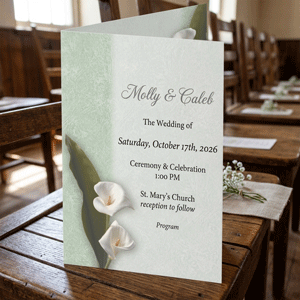
Keep the cover simple. For formal wedding program wording, names, date, time, and place are enough, with nothing else competing for attention.

Choosing the Right Tone and Style
The wording of your program should sound like your ceremony. Most programs fall somewhere between two styles:
- Formal: Traditional headings and spelled-out times, such as “at half past five o’clock in the evening.” Use titles and full names, for example “Processional” and “Exchange of Vows.”
- Casual: Warmer, conversational headings, such as “Welcome from our officiant” or “Everyone, please welcome the wedding party.”
- Somewhere in between: A traditional layout with a few relaxed touches, such as first names only for the wedding party.
To reflect your personality through language, take your cue from your invitations. If they were formal and traditional, the program should be too. A beach, backyard, or barn wedding can handle a lighter voice. Whatever you choose, stay consistent from the cover to the last line.
A Sample Wedding Program, Line by Line
This sample of wedding ceremony program wording follows traditional etiquette. Replace everything in brackets with your own details and delete any part you will not use.
Cover:
The Marriage Ceremony Uniting
[Full Name]
and
[Full Name]
on [Day of week], [Month] [Day], [Year]
at half past five o’clock in the evening
[Ceremony Venue]
[City, State]
Order of Ceremonies:
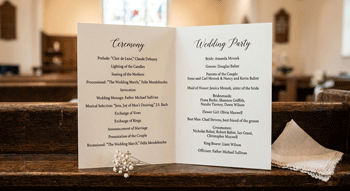
- Prelude ………. [Piece or performer]
- Lighting of the Candles
- Seating of the Mothers
- Processional ………. [Piece]
- Invocation
- Wedding Message ………. [Officiant Name]
- Musical Selection ………. [Piece]
- Exchange of Vows
- Exchange of Rings
- Announcement of Marriage
- Presentation of the Couple
- Recessional ………. [Piece]
Wedding Party (in order):
- Parents of the couple
- Grandparents of the couple
- Maid or matron of honor
- Bridesmaids
- Junior and honorary attendants
- Flower girl
- Best man and groomsmen
- Ring bearer
- Officiant
- Musicians
Notice the pattern: each line is a short label, with a name or piece of music only where one is needed. Dot leaders (“Prelude ………. [Piece]”) are a traditional way to line up music and names on a formal program. Not every part is necessary — choose what applies to your ceremony, and use the same spelling and the same titles every time a person appears.
Common Wording Mistakes to Avoid
- Overly complicated language. Short headings and plain words are easier to follow, especially in low light. If a guest has to pause to decode a line, simplify it.
- Inconsistent formatting and style. Pick one way to list names (full names or first names), one way to write titles, and one capitalization style, then use it throughout.
- Wrong order of events. Confirm the sequence with your officiant so the program matches what really happens, including where the seating of parents falls.
- Forgetting to proofread. Check every name, title, date, and time, and ask someone who did not write it to read it too. A typo in a name is hard to unsee in a keepsake.
- Leaving someone out or misnaming a role. Compare the wedding party and family lists against your plans, and check how each person wants their name and title to appear.
- Hard-coding details in a template. If you reuse a sample, replace every date, name, and piece of music, so details from the example do not slip into the printed program.
Creative Wording Ideas for Unique Touches
Once the basics are in place, a few personal touches make the program yours. Popular choices include:
- Personal messages or quotes. A short welcome from the couple, a poem, or a line that is meaningful to the two of you. See 10 Quotes for Wedding Ceremony Programs for ideas.
- Fun facts about the couple. A few lines on how you met, or a quick timeline of your relationship.
- Special acknowledgments. A thank-you to family and friends, such as “Thank you to our families and friends for the love and support that brought us here today,” or a dedication to a loved one who is with you in spirit.
- Helpful extras. Directions to the reception or a short note about a ritual guests will see, such as “Unity Candle: the couple lights a single candle to symbolize two lives joined as one.”
Keep each “extra” short. A program with one or two meaningful additions reads better than one stuffed with everything.

Incorporating Cultural or Religious Elements
If your ceremony includes cultural or religious traditions, the program is a good place to explain them to guests who may not know the customs. A few guidelines:
- Respect the tradition. Use the names and terms your officiant, clergy, or family use for each ritual, and check spellings with them. If the ceremony includes prayers or readings in another language, consider printing a short translation or explanation.
- Explain, don’t over-explain. One or two lines under a ritual heading is plenty. For example: “Handfasting: the couple’s hands are bound together as a symbol of their commitment.”
- Blend with personal touches. You can keep the traditional order of service and add a personal welcome, a family dedication, or a favorite reading in its own labeled line.
Ask your officiant or religious leader to review the program before printing. Different traditions have their own required wording, so check any requirements rather than assuming a standard template fits.
Design and Layout Considerations
Wording and design work together. A well-organized layout makes your wording easier to read, and clear wording keeps the design from feeling cluttered.
Choose a legible font for the main text and save decorative scripts for the names on the cover. Use two or three fonts at most, and make sure the ink has strong contrast against the paper. Echo the colors and graphics of your invitations so the whole stationery set feels connected, and add a monogram or simple graphic if you like.
Format matters too. A single flat card suits a short ceremony, while a folded program has room for the full order of events and the wedding party. Leave white space around each section so guests can scan it quickly. For help choosing a stock, see Wedding Program Paper Options.
Final Touches Before Printing
- Review and get feedback. Have the officiant, a parent, and a friend read the program against the actual plan for the day.
- Choose the right paper and printing method. Heavier paper holds up well in a hot room or when guests use the program as a fan. Print one test copy first to check alignment and spacing. Browse PaperDirect’s Program Paper for Events for options.
- Plan the assembly and distribution. Fold, trim, or tie the programs ahead of time, then ask an usher, attendant, or a friend to hand them out at the entrance, or place them on seats or a table.
If your date is close, Last Minute Wedding Programs! has tips for getting programs finished quickly.
A Keepsake Worth Getting Right
Proper wording keeps your wedding program clear for guests and polite to everyone it names. Include the essentials, choose a tone that matches your wedding, proofread carefully, and add a personal touch that makes it meaningful.
Ready to put your wording into print? Browse PaperDirect’s wedding ceremony programs to find the format and paper that suit your ceremony.
FAQ
What is the proper wording for a wedding ceremony program?
Proper wedding ceremony program wording uses a clear, consistent order: the couple’s full names, date, time, and location on the cover, then the order of ceremonies, then the wedding party with titles. Formal programs use traditional terms such as Processional, Exchange of Vows, and Recessional. Confirm the order with your officiant before printing.
How do you word a wedding program?
Start with a simple cover, then list each part of the ceremony in order using short headings. Name readers, musicians, and the officiant beside their parts, and add a wedding party list with each person’s role. Match the tone to your invitations, keep it consistent, and proofread every name before you print.
Where can I find examples of wedding program wording?
A sample is a good starting point. The sample program in this guide shows a traditional cover, order of ceremonies, and wedding party list that you can adapt. Replace the names, dates, and music, delete any part that does not apply to your ceremony, and add a personal note or quote if you like.