
Wedding invitation wording is the text that tells guests who is hosting, what is being celebrated, and when and where it takes place. A standard invitation follows a simple order: the hosts, an invitation line such as “request the honor of your presence,” the couple’s names, the date and time, and the location. That structure works for any wedding, but the hosting line is where family situations show up.
Divorced or remarried parents, stepparents, a loved one who has passed away, and close friends who feel like family all affect the wording. Etiquette guides don’t always agree on the details, and that’s okay — the goal is to find wedding card invitation wordings that feel honest to your family, not to follow a single rigid rulebook.
This guide gives you the basics of wedding invitation wording, then walks through sample wording for divorced parents, remarried parents, stepparents, deceased loved ones, chosen family, and more, so everyone who matters to you is honored. When your wording is ready, browse PaperDirect wedding invitations to put it on paper.

Understanding Complex Relationships
In wedding planning, a complex relationship simply means a family situation that doesn’t fit the classic “Mr. and Mrs. [bride’s parents] invite you to the marriage of their daughter” template. It’s very common, and nothing to be embarrassed about. Examples include:
- Divorced parents, with or without new partners
- Remarried parents and stepparents who helped raise you
- Blended families with several sets of parents involved
- A parent or loved one who has passed away
- A single parent hosting alone
- Couples hosting their own wedding, or two people of any gender marrying
- Close friends, mentors, or chosen family who play a role as important as any relative
Acknowledging these relationships on the invitation matters for two reasons. It honors the people who are part of your story, and it gives guests helpful context. For example, the wording can quietly signal that a parent has passed away or has a new spouse, so guests avoid awkward questions. Even in difficult family situations, thoughtful wording can help everyone feel respected, and it can set a warmer tone for the future.
Traditional vs. Modern Wording
Most wedding invitation wording falls somewhere between two styles:
- Traditional: Formal and third person, with hosts named first, the date and time spelled out, and a phrase like “request the honor of your presence.” It’s centered, uses full names and titles, and avoids abbreviations. See Formal Invitations for styles that suit this wording.
- Modern: Warmer and more relaxed, often skipping the host line or using first-person wording such as “Together with our families, we invite you to celebrate our marriage.” Dates and times are usually written with numerals.
- In between: A traditional layout with a personal touch, such as formal hosting lines paired with a short, warm closing line.
Here’s the same couple shown in both styles. Line breaks are shown with a slash, and bracketed items are placeholders to swap for your own details.
Traditional, couple and parents together:
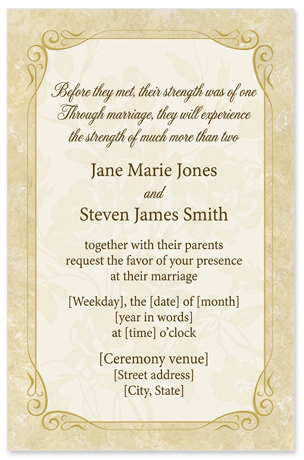
Before they met, their strength was of one
Through marriage, they will experience
the strength of much more than two
Jane Marie Jones
and
Steven James Smith
together with their parents
request the favor of your presence
at their marriage
[Weekday], the [date] of [month]
[year in words]
at [time] o’clock
[Ceremony venue]
[Street address]
[City, State]
Modern, couple hosting:
Together with our families
Jane and Steven
invite you to celebrate their marriage
[Month] [date]
[Time]
[Venue name]
[City, State]
Reception to follow
A common convention is “honor” (or “honour”) for a ceremony in a house of worship and “the pleasure of your company” for a reception or non-religious venue. Conventions vary, so choose what suits your families and keep the spelling consistent across your invitation suite.
Including Parents and Stepparents
The hosting line should name whoever is actually inviting guests, and it should be kind to everyone listed. Etiquette guides don’t always agree here, so use these samples as a starting point and confirm how each person wants to be named. Many guides also suggest ordering names the way the people involved prefer.
Divorced parents hosting together. Many guides place each parent on a separate line, with no “and” between them — an “and” can suggest they’re still married — and often list the mother first.
Ms. Anne Marie Jones
Mr. John J. Jones
request the honor of your presence
at the marriage of their daughter
Jane Marie Jones
and
Steven James Smith
[Weekday], the [date] of [month]
[year in words]
at [time] o’clock
[Ceremony venue]
[Street address]
[City, State]
Dinner and dancing to follow
Mother remarried, hosting alone.
Mrs. Anne Marie Hughes
requests the honor of your presence
at the marriage of her daughter
Jane Marie Jones
to
Mr. Steven James Smith
[Weekday], the [date] of [month]
[year in words]
at [time] o’clock
[Ceremony venue]
[Street address]
[City, State]
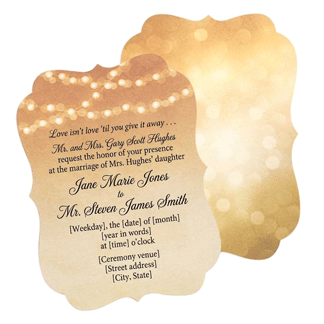
Mother and stepfather hosting. A parent and a new spouse can appear together on one line.
Love isn’t love ’til you give it away . . .
Mr. and Mrs. Gary Scott Hughes
request the honor of your presence
at the marriage of Mrs. Hughes’ daughter
Jane Marie Jones
to
Mr. Steven James Smith
[Weekday], the [date] of [month]
[year in words]
at [time] o’clock
[Ceremony venue]
[Street address]
[City, State]
Both parents remarried. If listing everyone feels crowded, “together with their families” is a graceful, widely used alternative.
Together with their families
Jane Marie Jones
and
Steven James Smith
invite you to celebrate their marriage
[Weekday], the [date] of [month]
[year in words]
at [time] o’clock
[Ceremony venue]
[Street address]
[City, State]
One parent hosting. A single host uses the singular verb: “requests,” not “request.” A single host is simply the person inviting guests, and the invitation doesn’t need to explain who isn’t hosting.
Ms. Anne Marie Jones
requests the honor of your presence
at the marriage of her daughter
Jane Marie Jones
to
Mr. Steven James Smith
Including stepparents is a personal choice. Add a stepparent to the hosting line if they’re hosting or helped raise you and want to be named; otherwise, “together with their families” covers everyone without naming individuals. If parents have different surnames, give the bride’s or couple’s full names so guests see the connection. If a host holds a military title, see Wedding Invitation Wording for Military Titles for how to list it.
Honoring Deceased Loved Ones
Many couples want to acknowledge a parent or loved one who has passed away. There’s no single rule, and guides differ. Common options include:
- Leave the hosting line to the living host. The simplest traditional approach has the surviving parent or relative host, with no mention of the person who has passed.
- Add “the late” in the relationship line. Many modern guides accept wording such as “daughter of Mrs. Jane Hartley and the late Mr. Robert Hartley,” while some traditional guides prefer not to name a deceased parent as a host.
- Add a short memorial line. For example, “In loving memory of [name]” at the bottom of the invitation, or a short tribute in your ceremony program or on a reserved seat.
- Use a verse. A short, optional line at the top can acknowledge loss or togetherness without explaining anything.
One parent deceased, remaining parent not remarried:
God has led two lives
to take one path
Mr. John J. Jones
requests the honor of your presence
at the marriage of his daughter
Jane Marie Jones
to
Mr. Steven James Smith
[Weekday], the [date] of [month]
[year in words]
at [time] o’clock
[Ceremony venue]
[Street address]
[City, State]
Both parents deceased, relative hosting:
Mr. Jonathan H. Jones
requests the honor of your presence
at the marriage of his sister
Jane Marie Jones
to
Mr. Steven James Smith
[Weekday], the [date] of [month]
[year in words]
at [time] o’clock
[Ceremony venue]
[Street address]
[City, State]
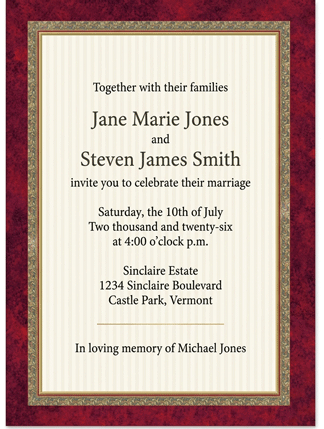
Memorial line, couple hosting:
Together with their families
Jane Marie Jones
and
Steven James Smith
invite you to celebrate their marriage
[Weekday], the [date] of [month]
[year in words]
at [time] o’clock
[Ceremony venue]
[Street address]
[City, State]
In loving memory of [name]
Keep any mention brief and match the tone of the rest of the invitation. If you prefer more room for a tribute, the ceremony program or a toast is often a better place.
Inviting Friends and Chosen Family
Chosen family — the friends, mentors, and relatives by choice who feel like family — can be recognized on an invitation too. There’s no fixed etiquette rule here, so the goal is to be inclusive and clear. A few approaches:
“Together with their families and friends.” A simple, inclusive way to signal that the people around you are part of the celebration.
Name a chosen family member as host. If a close friend or mentor is hosting or helping to host, name them on the hosting line the same way you would a parent, with their permission.
Ms. Rita Alvarez
requests the pleasure of your company
at the marriage of
Jane Marie Jones
and
Steven James Smith
Couple hosting. When the couple hosts, no one is named as host at all, and every guest is simply invited to celebrate.
Jane Marie Jones
and
Steven James Smith
invite you to celebrate their marriage
Thank them elsewhere. A line in the ceremony program or on your wedding website can honor chosen family without changing the invitation.
These same approaches work for any couple, whatever their genders, because the wording only needs the names of those inviting and those marrying. Name order is up to you; many couples go alphabetically or in whatever order sounds right to them.
Cultural and Religious Considerations
Culture and faith can shape invitation wording in ways that matter a great deal to families. Because traditions differ widely, ask the families and your officiant what they expect before you finalize the wording. Common examples include:
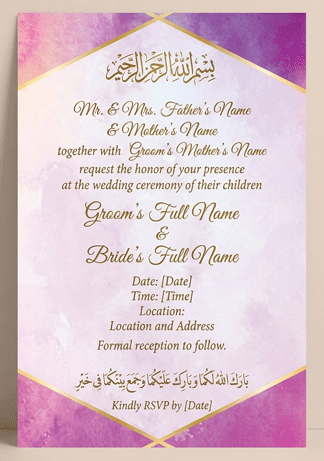
- A blessing, invocation, or verse at the top of the invitation, common in many faith traditions
- Names written in more than one language or script, or a bilingual invitation so older relatives can read it easily
- “Son of” and “daughter of” lines that name parents or grandparents, which some families expect
- Wording for a religious ceremony (“request the honor of your presence at the marriage of”), compared with a civil ceremony or reception (“request the pleasure of your company”)
Treat all of these as options to discuss with your families, not rules. For Christian ceremony wording specifically, see Invitation Wording for a Christian Wedding.
Personalizing Your Invitation
Personal touches make an invitation feel like yours, whichever style you choose. If you’re looking for unique wedding invitation wording, start with how you and your partner actually talk. A short line you’d say out loud beats a formal phrase that doesn’t sound like you.
Ideas for adding a personal touch while keeping the details clear:
- A short verse or quote at the top that reflects your story
- A warm closing line, such as “Dinner and dancing to follow” or “Join us for a celebration of love”
- A first-person line in a modern invitation, such as “We can’t wait to celebrate with you”
- A simple monogram or illustration that echoes the wording
A celebration after a private ceremony:
My family, your family, blending as one
Sharing, caring, a new life’s begun
Jane Marie Jones
and
Steven James Smith
are pleased to announce their marriage
on [date] during a private ceremony
Please join us for a celebration
[Date and time]
[Venue name]
[City, State]
Keep the essentials — who, what, when, where — easy to find, and put extras like directions and registry details on an enclosure card or your wedding website. For ideas on matching your style, browse PaperDirect wedding invitations.
Insert product photo here: a sample invitation suite with enclosure cards.
Common Mistakes to Avoid
Wording errors are easy to miss because you’ve read the draft a dozen times. Watch for these:
- Listing divorced parents with “and” between them on one line, which can suggest they’re still married
- Naming a person without checking how they want to be listed (title, spelling, or surname)
- A weekday that doesn’t match the date — check a calendar before you print
- Mixing formal and casual language, or spelling “honor” two different ways across the invitation suite
- Putting registry details on the invitation instead of an enclosure card
- Leaving out the reception line, so guests are unsure whether a meal is included
- Using wording that unintentionally implies something about the family, such as treating a single host as a sign that a parent is absent
Proofread out loud, check every name and title against what each person actually uses, and ask someone who hasn’t seen the draft to read it over. If a family member is likely to be sensitive about the wording, check with them before printing. For the envelopes, see How to Address Wedding Invitations.
FAQ
What is the proper wording for a wedding invitation?
Proper wedding invitation wording names the hosts, includes an invitation line such as “request the honor of your presence,” names the couple, and gives the date, time, and location. Traditional invitations use third person and spell out the date and time. Modern invitations are warmer, such as “Together with our families, we invite you to celebrate.”
How do you word a wedding invitation when parents are divorced?
Many etiquette guides list divorced parents on separate lines with no “and” between them, often with the mother first, followed by “request the honor of your presence at the marriage of their daughter.” If a parent has remarried, they may appear with their spouse on one line. “Together with their families” is a simpler option.
How do you honor a deceased parent on a wedding invitation?
Common options include a surviving parent or relative hosting, a relationship line such as “daughter of Mrs. Jane Hartley and the late Mr. Robert Hartley,” or a short “in loving memory of” line. Guides differ on using “the late,” so choose what feels right, and save a longer tribute for the ceremony program.
Do you include stepparents on a wedding invitation?
It’s a personal choice. Include a stepparent on the hosting line if they’re hosting or helped raise you and want to be named, for example as a couple with the parent on one line. If listing everyone feels crowded, “together with their families” honors every family without naming each person.
Choosing Words That Fit Your Family
Thoughtful wedding invitation wording is about showing respect to everyone who matters to you and giving guests the details they need. Start with the standard structure, adapt the hosting lines to fit your family, and choose a tone that sounds like you. Whatever your family looks like, the right words can welcome everyone and set a warm tone for the day.
Ready to put your wording on paper? Browse PaperDirect wedding invitations or explore formal invitations to find a style that fits your wedding.
